| Language : | English |
| Duration : | 4 years / 8 semesters |
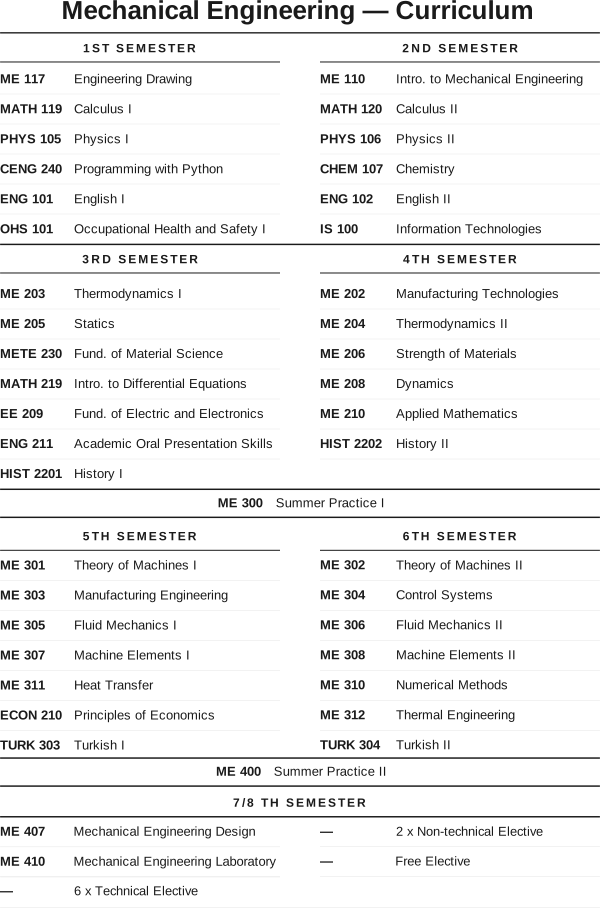
| * The undergraduate curriculum leading to the degree of Bachelor of Science in Mechanical Engineering is spread over eight semesters in four years. |
The Bachelor of Science curriculum in Mechanical Engineering is composed of compulsory courses that provide students with strong foundations in mathematics, basic sciences, engineering sciences, design, manufacturing, thermodynamics, fluid mechanics, solid mechanics, dynamics, control, and laboratory practice. These must courses form the core structure of the program and prepare students for advanced technical electives, design projects, internships, and professional engineering practice.
There are four types of elective courses in the undergraduate program of Mechanical Engineering:
- Restricted Elective: 1 course
- Technical Electives: 5 courses
- Free Elective: 1 course
- Non-Technical Electives: 2 courses
Lastly, the opening frequency document of the undergraduate technical elective courses in the Mechanical Engineering Department could be reached in this link. Students who started the Mechanical Engineering Department prior to the 2006–2007 academic year have to take one additional Non-Technical Elective or ENG 311 to graduate.
> For more information on elective courses, click here.
> Please click here to learn about the rules of taking technical elective courses from other departments.
The Mechanical Engineering curriculum includes senior-level design and laboratory experiences that help students transform theoretical knowledge into practical engineering solutions. In the compulsory course ME 407 Mechanical Engineering Design, student groups work on design problems that require analytical ability, technical judgment, creativity, innovation, teamwork, and prototype development. The resulting prototypes are tested and evaluated according to pre-established criteria.
In ME 410 Mechanical Engineering Systems Laboratory, students conduct experiments on systems such as internal combustion engines, turbomachinery, energy conversion equipment, metrology and quality control systems, vibrating machinery, and machine tools. These experiences strengthen students’ ability to analyze real engineering systems and connect classroom knowledge with experimental practice.
In ME 410 Mechanical Engineering Systems Laboratory, students conduct experiments on systems such as internal combustion engines, turbomachinery, energy conversion equipment, metrology and quality control systems, vibrating machinery, and machine tools. These experiences strengthen students’ ability to analyze real engineering systems and connect classroom knowledge with experimental practice.
All undergraduate students of Mechanical Engineering are required to complete industrial training during their undergraduate study. Students spend a minimum of four weeks, twice during their undergraduate education, in industry to gain practical experience and observe real engineering environments.
Some courses in the undergraduate curriculum have prerequisite requirements. Students should review these requirements carefully while planning their course registrations.
> Click here for course prerequisites.
> Click here for course prerequisites.
Last updated