| Language: | English |
| Duration: | 4 years / 8 semesters |
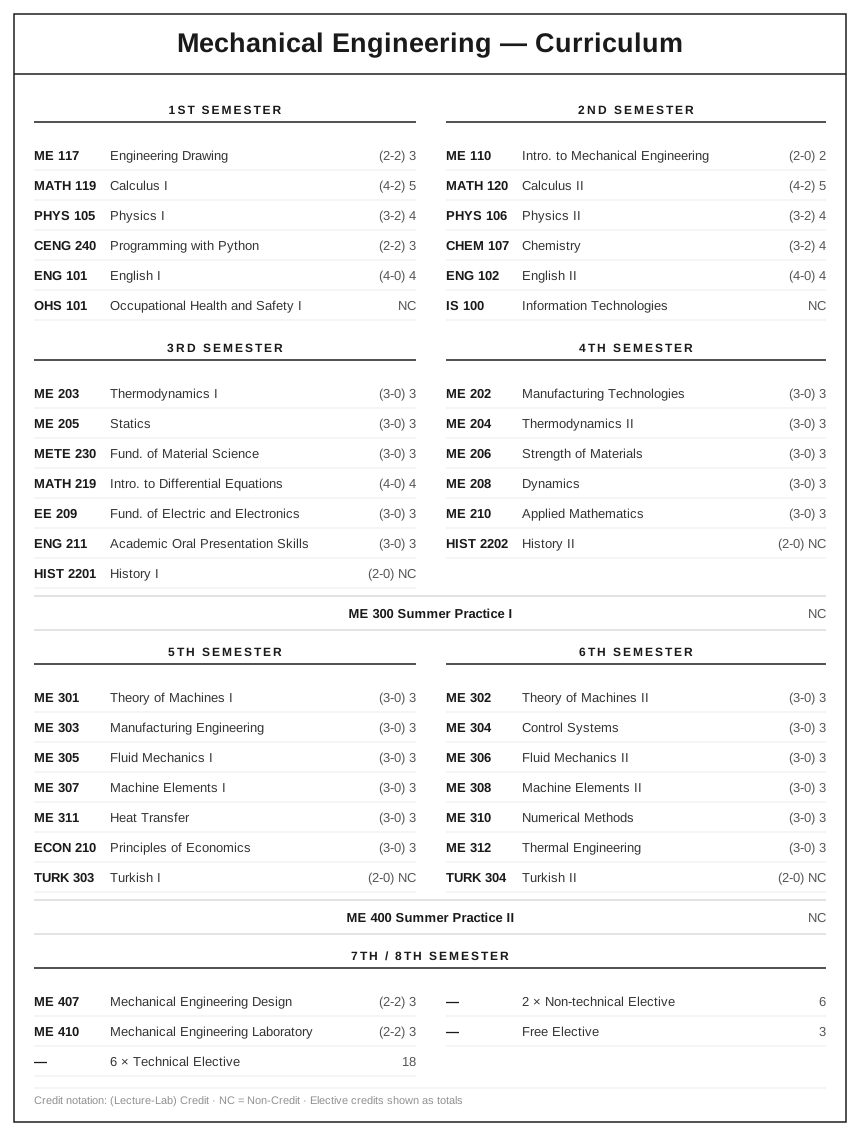
| *The undergraduate curriculum leading to the degree of Bachelor of Science in Mechanical Engineering is spread over eight semesters in four years. |
Compulsory courses form the core of the Mechanical Engineering curriculum and provide the fundamental knowledge required for advanced engineering analysis, design, and practice. These courses cover mathematics, physics, chemistry, computing, engineering sciences, mechanical engineering fundamentals, laboratories, and design courses. Detailed information regarding course contents, credits, prerequisites, and learning outcomes can be found in the course catalog. Many compulsory courses have prerequisite relationships to ensure that students acquire the necessary background before taking advanced courses.
Useful Resources:
The curriculum allows students to tailor their education according to their interests through elective courses. In addition to the compulsory courses, students are required to complete:
- 6 Technical Elective courses
- 2 Non-Technical Elective courses
- 1 Free Elective course
Technical Electives: Technical electives enable students to deepen their knowledge in specific areas of mechanical engineering such as design, manufacturing, robotics, control, energy systems, materials, biomechanics, computational engineering, and related fields.
Students may also count one approved graduate-level Mechanical Engineering course (except ME510 and ME521) toward their technical elective requirements, subject to departmental regulations and advisor approval.
One of the technical elective courses may be taken from another engineering department of METU with certain restrictions, subject to the approval of the course instructor and the advisor of the student.
Useful resources:
- Technical Elective Course Catalog
- Technical Elective Opening Frequency Document
- Graduate Course Catalog
- Graduate Course Opening Frequency Document
- Rules of Taking Technical Elective from Another Department
Non-Technical Electives: Non-technical electives are intended to broaden students' perspectives beyond engineering and may include courses from the social sciences, humanities, arts, management, economics, entrepreneurship, and other disciplines. A comprehensive list of accepted non-technical elective courses could be found on faculty of engineering webpage.
Free Elective: The free elective requirement allows students to take a course of their choice from any department, subject to prerequisite requirements and course availability. This provides additional flexibility for students wishing to explore interdisciplinary interests or complement their technical education.
The Mechanical Engineering curriculum includes senior-level design and laboratory experiences that help students transform theoretical knowledge into practical engineering solutions. In the compulsory course ME 407 Mechanical Engineering Design, student groups work on design problems that require analytical ability, technical judgment, creativity, innovation, teamwork, and prototype development. The resulting prototypes are tested and evaluated according to pre-established criteria.
In ME 410 Mechanical Engineering Systems Laboratory, students conduct experiments on systems such as internal combustion engines, turbomachinery, energy conversion equipment, metrology and quality control systems, vibrating machinery, and machine tools. These experiences strengthen students’ ability to analyze real engineering systems and connect classroom knowledge with experimental practice.
ME300 and ME400 summer practices are an integral component of the Mechanical Engineering curriculum and provide students with exposure to real engineering environments. Through summer internships, students gain practical experience, observe engineering applications in industry, and develop professional skills that complement their academic education. The department requires students to complete the mandatory summer practice requirements before graduation. Detailed information regarding summer practice types, durations, application procedures, report requirements, and evaluation criteria can be found on the department's summer practice webpage.
Useful resources: